Pages

Friday, June 24, 2016

Focus on the Learning: The Power of Mastery

We all know that learning is messy.  We've seen this messiness over and over again in our classrooms.  I happened across this modified image from Demetri Martin in a blog post by George Couros recently and I think it accurately illustrates the idea of learning.  


Photo Credit:  George Couros - goo.gl/sL5Ksa


One of the questions I've asked myself over the last few years is what is the best way to ensure that every one of my students is learning, while keeping in mind that the journey towards understanding and sense making is often fraught with wrong turns, left turns, right turns and switchbacks and that every learner's final path is different.  


This year, I decided to address the varying paths to learning through mastery learning.  Mastery learning is not a new idea.  According to “Lessons of Mastery Learning” published by ASCD, Benjamin Bloom, creator of Bloom's taxonomy, first introduced the idea in the early 1970's.  Essentially, in mastery learning, the learner must demonstrate mastery of a concept, idea or topic before moving forward in their learning.  Using the Schoology platform, specifically Schoology's learning objectives, student completion rules and mastery features, I incorporated mastery learning into my classroom this year.  


We know that it is critical to begin with the end in mind.  In order for our students to master anything, they need to know where they are headed.  In our classroom, I use learning objectives to accomplish this.  Briefly, learning objectives are created in your Schoology Resources.  You can create your own customized learning objectives or access and use state and/or national standards.  I have chosen to primarily use the Colorado State Science standards as my learning objectives.  After adding specific learning objectives in my Schoology Resources, I attach them to specific assignments by adding rubrics.  While I assess student understanding using a mastery scale, my school still assigns traditional grades.  In order to merge mastery grading with my school’s traditional grading system, I have created a Mastery Grading Scale based on Marzano's work on standards based grading.  
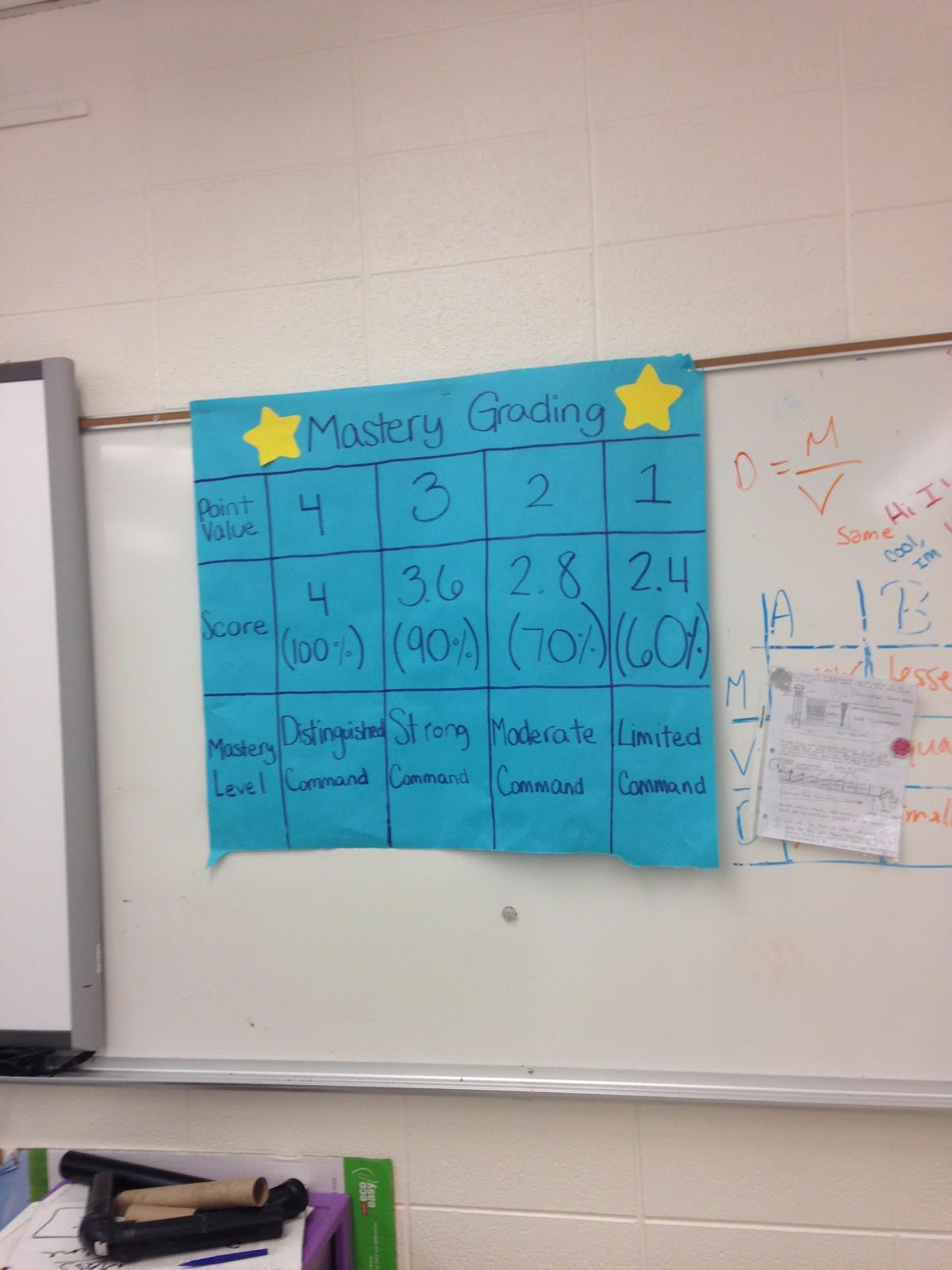

I customize every rubric that I create to reflect this scale.  

For student’s to move on, they must, at minimum, demonstrate "moderate command" of each learning objective.  Keeping in mind that learning is messy, I know that not all students will meet this expectation the first, second or sometimes even the third time.  To account for this, I use student completion rules.  These rules are easy to set up in each unit.  I allow students to revise their work as many times as they want to.  Ultimately, I want them to learn, I don't care how long or how many tries it takes.  Learning is the goal, not completion!  


This brings us to the last Schoology feature that I use to ensure that learning is happening, mastery.  I approach at mastery in two different ways.  First, I use student completion rules on assignments aligned with our learning objectives.  This works great for those learning objectives that are more short-lived.  But there are also a handful of learning objectives that students are working towards mastering for the entire year.  This is where the Schoology mastery feature is critical.  If I have a learning objective that I use over and over again, I can easily keep track of a student's progress towards mastery using this feature.
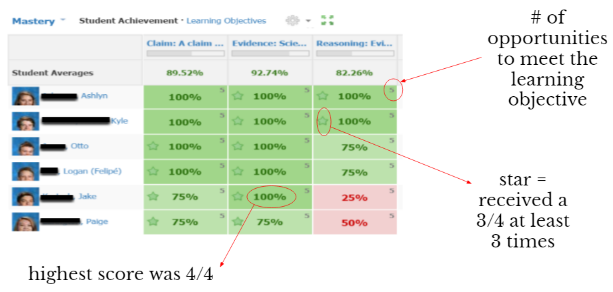


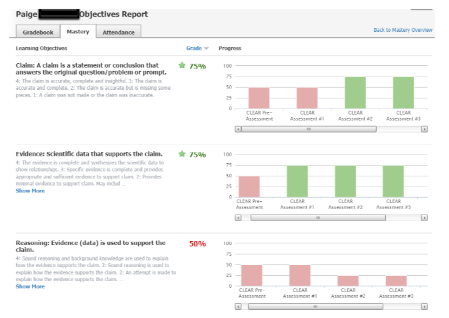
I can even look at an individual's progress towards specific objectives in order to determine how to help her successful master the idea.  

To conclude, when we account for the messiness of learning and really focus on learning rather than completion, amazing things start to happen in the classroom.  My ability to use the Schoology platform to easily add learning objectives to assignments and to add student completion rules as well as using the mastery feature has significantly changed our classroom focus.  Students understand purpose as they work towards understanding rather than a "grade".  This change in focus in reflected in the amount of revisions I see on a daily basis.  It is reflected in the conversations that happen among my students as they work on defining and refining their understandings. It is reflected in the smiles of both my non-traditional and traditional students who  suddenly find success in school when historically they haven't because they have time to work through their ideas and their understandings.  It is reflected in the deep, thoughtful thinking that occurs as students realize that learning isn't usually straightforward and although it takes hard work, it is incredibly satisfying.

Tuesday, June 21, 2016

Status Quo

Recently, my daughter had to make an important decision. She had to decide if she wanted to maintain status quo. Would she stay with what was comfortable and easy, but overall incredibly unsatisfying or step outside of her comfort zone and do something different, something uncomfortable, something scary, but something that was ripe with opportunity and potential.


I am proud to say that she went for the latter choice. It’s easy to stay safe, it’s easy to encourage the safe choice. After all, if it’s safe, as a parent we know what to expect, as an individual, things become more predictable, life gets easier. But life shouldn’t be about predictability, it should be rich and exciting and satisfying. Our experiences should push us as human beings, they should stretch our comfort zones and our minds. Experiences should expose us to new things, different ways of thinking, new people, new ideas. Safe is boring, safe rarely helps us grow and become better stewards of our communities, our amazing planet and ultimately our families and ourselves.

Over and over again in my school, I see safe choices. Maybe it’s a student that is good at school, always following the directions, staying with the lines, aiming for the right grade rather than the learning. Maybe it’s a teammate that hangs back and watches everyone else manipulate an idea, a new design, a question, an experiment, only stepping in when he is one hundred percent sure that he has it covered. Maybe it’s a teacher that sticks to what he knows, what he is comfortable with and what has successfully worked for him in the past even though it’s not working anymore. Maybe it’s an administrator that doesn’t want to rock the boat by encouraging her teachers to think differently.

I’ve never been what I would call a safe person. I certainly take more than my share of risks. You might not look at me or talk to me for the first time and think this, but I do. I like to say that I embrace, welcome and often times look for change. Many of my risks, my “jumping of the cliff” moments have occurred within the confines of my own classroom. Some have led to great things, some have led to massive failures. Despite the risks that I have taken within my classroom, I have also played it safe at the same time. I have taught in the same school for 15 years. I have taught the same subject and grade for 15 years. I have always justified this stagnation because I love what I do. But lately, it hasn’t been quite enough. I’m still challenged every day, but something is missing. My daughter provided me with great inspiration. I too have a potential opportunity to do something different within the confines of what I love to do, help kids learn. This opportunity would require me to step far outside of my comfort zone. It will be hard. I will have to leave the community that I has supported my growth and the development of my craft over the last 15 years. But change is good, risk is good, being a little bit uncomfortable is good for the mind, body and spirit.

Thank you Sage, for reminding me that the human spirit thrives under conditions of change.

Tuesday, May 31, 2016

Making Daily Pages a Habit

I've been thinking about doing something like this for a few months now. I started a blog, Reinventing Class, over three years ago with the goal to publish a post every month. I've only been averaging a handful of posts every year - 3 to 4 if I'm lucky.  Recently, I read a blog post by AJ Juliano, "How to Make Writing a Habit" which got me thinking about why I haven't met my blog goal. Habits can be hard to come by. I'm busy right?  I am; I have two kids involved in sports, one of whom practices every day. I live in the mountains so I commute 30+ minutes to the school where I teach science, my son swims in a town 30 minutes away from home and from where I teach, my daughter plays soccer and is a referee, I like to run most days, I have 2 dogs to take care of, I have a husband that deserves my attention as well, I’m a dedicated teacher who likes to be innovative and creative and likes to give timely, honest, helpful feedback.  I can make the list go on and on and the list is accurate. But, at the end of the day, my list is just another set of excuses.
18889959850_98e78984c5_m.jpg
If I want to write, if I think that it is important enough, then I just need to do it.  A few days ago,six to be exact, I read Will Richardson's post about the 750Words.com site, "Writing Every Day".  I found the purpose of this site really intriguing.  Basically, the underlying idea is to log-on and write at least 750 days everyday.  
6880096005_fe6a7eefac_m.jpg
Based on my blogging history, or lack of, over the last 3 years, I need to conscientiously develop a writing habit. This might be a great tool to encourage me as I try to develop and refine this new habit. I started last Friday, the first day of summer vacation. I just finished my fifth round of daily pages.  This is my first blog post to come out of my daily pages but I have about 3 more posts in the works.  It’s fun, it’s encouraging me to consistently capture my ideas and my reflections and it’s helping me begin my journey as a writer.  

Sunday, May 1, 2016

Ignite: A New Learning Experience

Last summer I decided to participate in an Ignite session at the InnEdCO 2015 conference.  The Ignite motto is “Enlighten us but make it quick”.   An Ignite is a fast paced, 5 minute talk where the presenter must use a pre-timed, 20 slide presentation.  In math terms, this means that each slide automatically advances after 15, very short, seconds.

My motivation to participate in the Ignite session was simple; I wanted to push my comfort zone and try something new.  I had presented at numerous conferences, but as a presenter, I had never experienced anything like an Ignite before.  I felt passionate about my focus and wanted to share my ideas and thinking with others using a non-traditional format.  Despite a minor technical glitch about midway through my allotted 5 minutes, my slides decided to stop automatically advancing, the Ignite went pretty well.  I walked away from the Ignite stage that day feeling like I had accomplished my goal.  I then spent the next few days debating if I should blog about the experience.  Standing up and sharing my Ignite with a couple hundred people was one thing, but sharing it publicly on my blog, well that, in one word, was just scary.  I thought about the post, I started a Google doc and titled the post, I even tracked down a video of my Ignite, but then July and August came and went, school started, life got crazy again, and I didn’t write the post.  If I’m honest, I didn’t write the post, not because I didn’t want to write about it, but because I was scared to post the video.  Silly, but true.


Fast forward ten months.  Today I finished “The Innovator’s Mindset” by George Couros (@gcouros). I found Mr. Couros’s book inspiring and so many of his ideas resonated strongly with me. In the later portion of his book, Mr. Couros emphasizes the importance of sharing our reflective thinking about our learning and our practice.

So, thank you George Couros, for convincing me that it’s not enough to think about and put into practice our ideas and our learnings. If we truly want to help move education forward, we must also share our honest reflections on our experiences and our learnings.  If you have 5 minutes, check out my Ignite: What If? by Erin Mayer.


Ignite Photo Credit: goo.gl/3MKcEW

Tuesday, January 5, 2016

Let's Focus on Thinking Instead


After returning from a long, relaxing and thoughtful winter break, our staff spent a lively hour discussing our school wide goal for this year.  I know, a little late, but we’ve been waiting on PARCC data.  For the last three years, our building focus has been writing.   
 
The challenge has been how to address and assess this goal across all of the different contents that are represented in our middle school.  We have tried using  a common acronym, RAP - Rephrase, Answer, Provide Support, but this acronym didn’t necessarily fit well with all content areas, sometimes felt contrived and overall, did not significantly impact on our student’s standardized test scores.  We also tried using common, school wide short constructed response assessments.  These assessments were cumbersome to score and due to the scoring time commitment, we were only able to give 2 or 3 over the course of the year.  Again, no one, teachers or students, were getting 
the bang for their buck.  
So what to do?

My personal philosophy on education has undergone radical changes over the last few years.  For many years of my career, I relied on traditional, summative assessments to determine what students knew.  Over the last five years, I realized that these traditional assessments more often than not gave an incomplete, and in many cases, an inaccurate, picture of student understandings.  They rewarded students who figured out what the teacher wanted and went about providing that answer and penalized students who thought outside the box.  

What is the purpose of education?  I grapple with this question frequently.   
 
My current belief, influenced greatly by my experiences raising 2 children and following their school experiences, is that at the end of the day, I want my own children as well as my students to be able to think.  I want them to be able to express their thoughts and opinions and support these ideas with credible, relevant and timely information.  How they express their ideas should be up to each individual.  The communication and presentation of ideas should be based on each individual child’s strengths and should involve thoughtful consideration of both audience and purpose.  For years, the primary mode of communication, at least in the formal education setting, has been text based with a heavy emphasis on formal writing.  I strongly believe we need to move away from this long-held assumption that all students must use formal writing as their primary mode of expression.  

So back to our school wide goal.  It’s so easy to default to writing - it’s what we’ve looked at for years, but is it really the most effective way to assess student growth?  Don’t get me wrong, I think being able to write is important and my students often communicate their understandings through writing.  But, I don’t think it is the only way, and certainly not always the best way, for students to demonstrate understanding and the ability to think deeply.  And I certainly don’t think it is the best way to quickly assess understanding in order to provide timely and productive feedback.  It is well past time to acknowledge that there are many ways to demonstrate the ability to think critically.  This acknowledgment is scary though.  How do you systematically assess deep thinking?  How do you standardize both assessments and assessment feedback so you can track growth? I wonder, what happens if you focus on the actual thinking, rather than the fallback measurement tool - more often than not, formal writing.  What if we acknowledge that there are many ways to show deep, complex thinking; for example, an intricate piece of art, a short video or audio recording, a bulleted list of words, a music composition, a sports formation. 
 
Formal writing does not need to be the end-all-be-all.  The world needs individuals who can express their ideas and thoughts, who can learn from their mistakes and move forward and who can think outside the box and confidently communicate their ideas.  Our staff began to consider this today.  
It was refreshing.  
It was exciting.  
It creates lots of unknowns.  
I’m looking forward to seeing where we end up.    

Wednesday, August 26, 2015

Sundays Are Hard


Transitions - for our most impacted students, and many others, transitions are hard.  Transition from elementary school to middle school, from 5th period to 6th period, from science to social studies, from Sunday to Monday. I get it; sometime during the last two years of high school, Sunday’s suddenly got hard for me. Thinking back, I’m pretty sure I was worried about my
impending “adulthood” and the soon to arrive transition to college. At the time, Sunday’s were just hard. I don’t think I ever told my parents about this. My worries came out on Sunday nights. After everyone was asleep, I’d wander from bedroom to bedroom, peeking in to make sure all was well. I often invited my youngest sister, just 10 years old, to sleep in my room pretending that I was doing her the favor not the other way around.


Ten days ago, our new school year began. I don’t know my 151 students very well yet but I do know that each one of them enters our classroom every day with their own strengths and worries and fears. I know that for many, Sundays are hard. I know that for many, transitioning from 1st period to 2nd period is hard. I know that for many, switching from subject to subject every 49 minutes is hard. I know that for many, transitioning from one activity to the next within a class period is hard. One of my goals this year is to focus on relationships. I only have 49 minutes every day with most of my
students but I plan to take advantage of this short period of time. Every Monday, we will begin class with a community building activity. I’ve also implemented a leader-board challenge for my students.  Participation is voluntary but all activities are focused on building both community and relationships, between the students and between the students and myself. I hope that when things get harder and when struggles become more apparent that I will be able to fall back on these relationships and use them to help kids and maybe help Sundays become easier.

Photo Credits
Handshake:   http://mrg.bz/8JrQuM

Tuesday, August 11, 2015

One Meaningful Adult


This morning, I had the privilege of hearing Jonathan Mooney speak at Arvada West High School.  Jonathan painted a poignant picture of his experience as a dyslexic, ADHD student and the role that pivotal adults in his life played as he navigated our education system.   Through a series of personal stories, Jonathan challenged our traditional educational practices, arguing that “we confuse the global faculty of intelligence with the skill of reading” and “when all we do is “fix” kids, the message they get is that they are broken”.  His message resonated strongly with me from both a personal perspective as a mom of a nontraditional student and from a professional perspective as a teacher who works with nontraditional and traditional students alike every day.  


I wrote about my own son in a recent post.  I could see my son in Jonathan Mooney as he stood before us on the Arvada West HS stage.  My son is a creative, inquisitive, inventive learner outside of school.  At school, he doesn't fit into the traditional definition of what constitutes a “good” student, which in his case primarily means that he is not a “good” reader.  He doesn't like school and I can understand why.  Jonathan challenged the 150 plus educators in the room to “build school experiences that ask how is this student smart, not how smart is this student” and that “we have the opportunity to help kids understand that intelligence isn't determined by 1 skill”.  I would love to watch my son and his teachers acknowledge and develop his strengths rather than always focusing on what he, and the traditional school system, call his deficits.


I also saw so many of the students I have had the opportunity to work with over the years in Jonathan.  Kids who walk into my science classroom with 7 years experience of being “fixed”.  Kids who think they have nothing to offer except trouble.  Kids with a fixed mindset who believe they aren't smart.  It is heartbreaking.  Jonathan reminded me of one student in particular that I had the privilege of working with last year.  This student was tough.  There were plenty of nights when I couldn't sleep trying to figure out how to reach him.  There were plenty of days when I had to take a deep breath after he said something rude or mean to myself or his classmates.  He hated school and who could blame him.  Four of his seven periods in the day were focused on “fixing” his deficits.  I don’t think he had any electives in his day because of all of the intervention classes.   Jonathan reminded us that “there is a strength in every student that is a pathway to success; our job as educators is to find it”.  It took months to develop a relationship with this particular student and then, just as we were finally figuring it out, the school year ended.  I hope that the tiny bit of success we had, the identification and development of his strengths which, yes, he has, carry forward this year for him and change his path.  

As I get ready to begin a new year of teaching with new students that each bring their own individual strengths, challenges and passions into the classroom, Jonathan reminded me that connections and relationships matter.  I need to remember this when the going gets tough.  I need to “define kids by what they can do, not what they can’t do”.  I need to ask “what are you good at” and not accept “nothing” for an answer.  I need to remember that every student has something to bring to the table and that it is my job to help them find and develop this nugget.  And I definitely need to remain an advocate for that student that I worked so hard with last year.  After all, one meaningful adult can put a child on a different path.

file0001251193695 (1).jpg